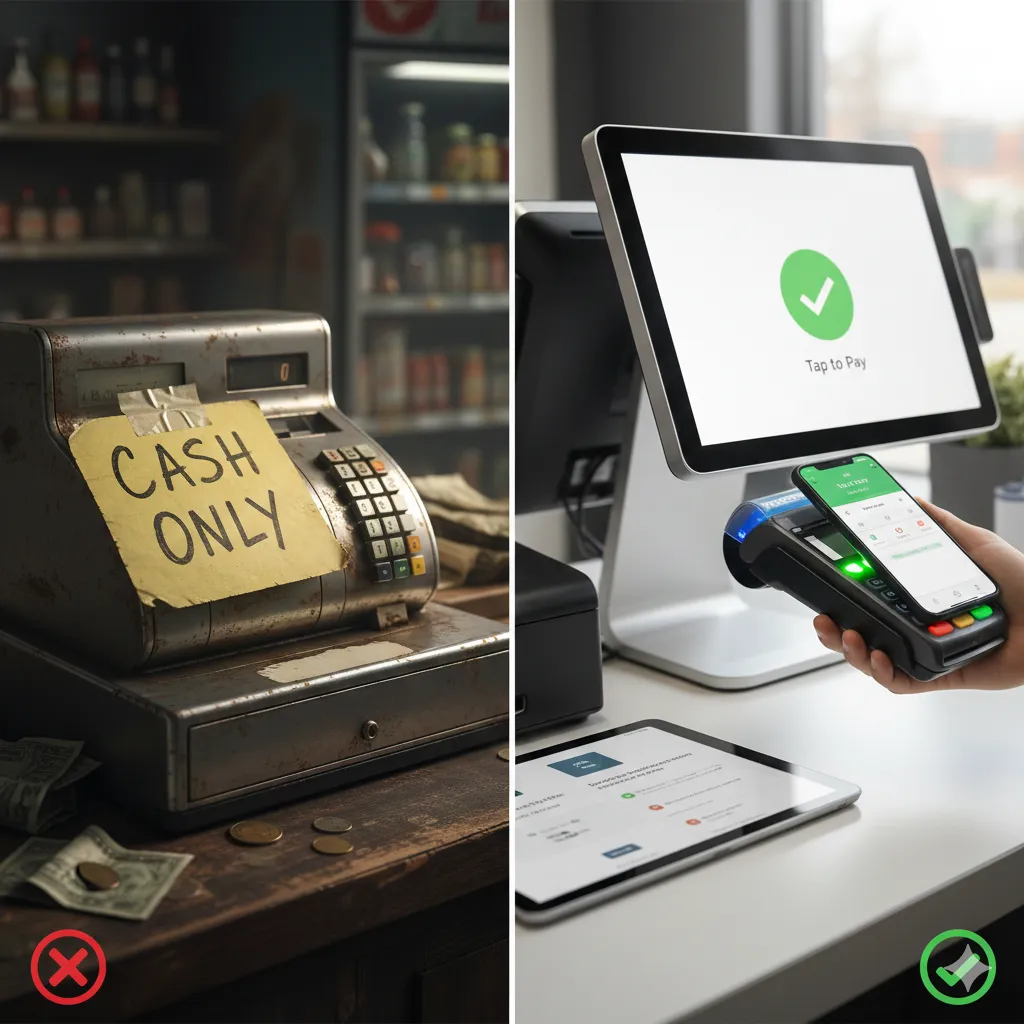
Cash vs. Card: Why "Cash Only" is the Most Expensive Way to Run a Business
I’ve met many business owners who wear their "Cash Only" sign like a badge of honor. They feel they’re outsmarting the system by avoiding the 3% merchant fee.
But at Payment Bridge Processing, when we look at the actual math of 2026 retail, we see a different story. The truth is that cash isn't free—it’s actually one of the most expensive ways to move money. If you are still turning away cards, you aren't saving 3%; you’re likely losing 15% or more in growth, security, and efficiency. Here is the breakdown of why the "Cash is King" era has officially ended.
1. The "Impulse" Gap: You’re Capping Your Sales
The psychology of spending has shifted. In 2026, the "friction" of physical cash acts as a spending brake.
The Math: Research consistently shows that consumers spend 12% to 18% more per transaction when using a card or digital wallet compared to cash.
The "Walk-Away" Factor: With digital wallet penetration hitting 45% at U.S. terminals this year, a "Cash Only" sign is essentially a "Closed" sign for nearly half of your potential customers. If they have to find an ATM to buy from you, they usually just find a competitor instead.
2. The Hidden "Cash Handling" Tax
Most owners forget to "invoice" themselves for the time spent managing paper money.
Labor Costs: Think about the time spent counting drawers, reconciling discrepancies, and making bank runs.
Shrinkage & Security: Cash is the only currency that can "disappear" through employee error or theft. Between internal shrinkage and the cost of armored transport or high-risk insurance, handling cash can cost a business anywhere from 4% to 15% of its total volume. Suddenly, that 2.6% processing fee looks like a bargain.
3. Missing the "Agentic" Revolution
We are currently entering the era of Agentic Commerce. In 2026, AI-powered shopping agents are beginning to make purchases on behalf of consumers. These agents can compare prices and complete transactions instantly—but they can’t carry a $20 bill. If your business isn't digitally integrated, you are effectively invisible to the automated economy.
The Smart Compromise: Cash Discounting
If you still hate the idea of "losing" money to fees, you don't have to go cash-only. Cash Discounting (or Dual Pricing) is the 2026 standard for savvy merchants.
You list a "Standard" price (which covers the card fee).
You offer a "Discounted" price for those who pay in cash.
This keeps your margins whole, keeps you compliant with card brand rules, and—most importantly—ensures you never have to tell a customer "No" at the register.
FAQs
Is it legal to charge more for credit cards in 2026?
Yes, but you must be careful. While "surcharging" has strict rules and is banned in some states, Cash Discounting (offering a lower price for cash) is legal in all 50 states and is the preferred method for modern POS systems like Clover or Valor.
What percentage of consumers still carry cash?
As of early 2026, only about 14% of transactions in the U.S. are conducted in cash. For Gen Z and Millennials, that number is even lower, with many reporting they leave their physical wallets at home entirely in favor of digital ID and payment apps.
How does "Tap-to-Pay" affect my business?
Tap-to-pay transactions are roughly 60% faster than chip-based payments and significantly faster than counting out change. In high-volume environments, this speed increases your "throughput," allowing you to serve more customers during peak hours.
Bridge the Gap to Higher Profits
Don't let a "Cash Only" sign be the ceiling on your business growth. In 2026, the most successful businesses are the most flexible ones.
Ready to see how much you’re losing to the "Cash Tax"? Contact Payment Bridge Processing for a Modernization Audit Stop counting pennies. Start scaling dollars.
