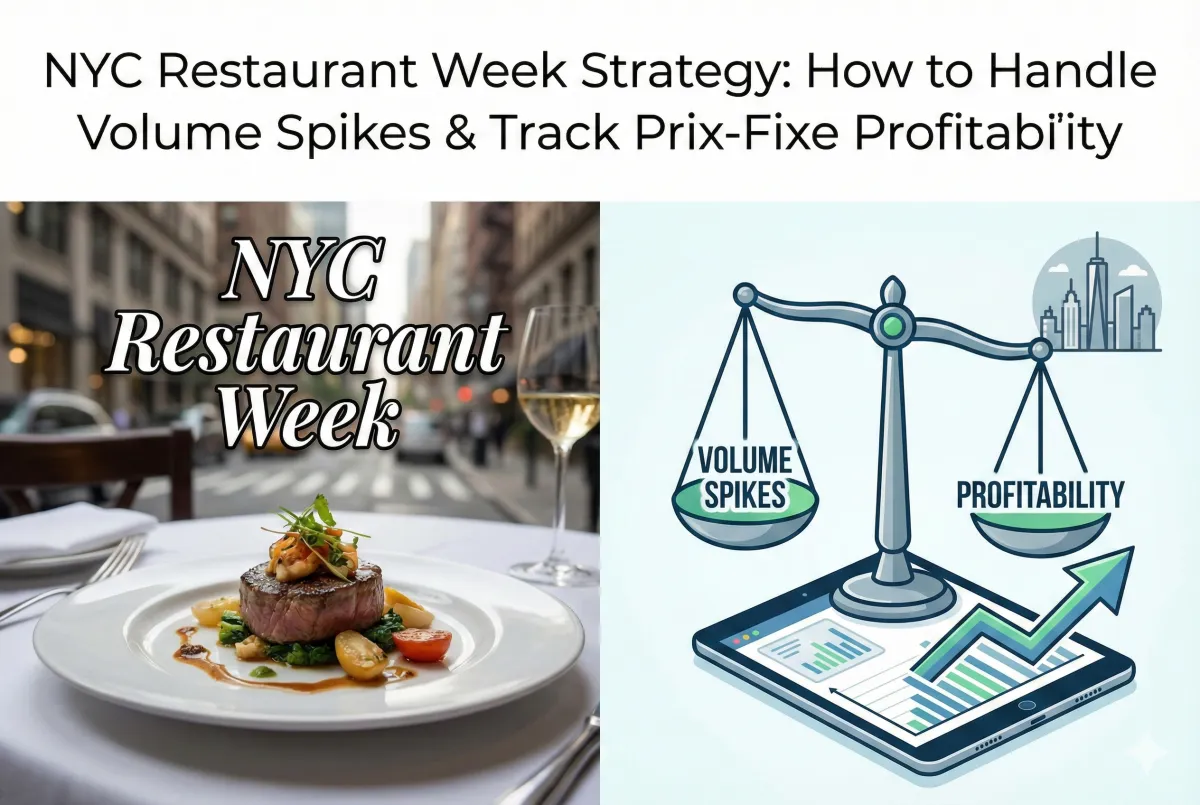
NYC Restaurant Week Strategy: How to Handle Volume Spikes & Track Prix-Fixe Profitability
Table of Contents:
Running a restaurant in New York City is already high-pressure.
Rent, staff, food costs, reviews, everything moves fast.
But nothing tests a restaurant like NYC Restaurant Week.
For many places, it brings the biggest crowds of the year.
For others, it becomes a stressful race where margins disappear, and the POS struggles under volume.
This guide breaks down how to handle the surge, protect your profit on prix-fixe menus, and use real analytics to see what is actually working.
Why Restaurant Week Creates Unique Challenges?
Restaurant Week brings a type of demand that your normal POS patterns do not see:
Short windows with heavy reservations
Prix-fixe pricing that changes your cost structure
Higher table turns
More card payments
Larger groups ordering at the same time
Tourists and new customers who expect a smooth checkout
All of this creates pressure on your kitchen, staff, and especially your POS and payment system.
If your system slows down or freezes, you lose table turns, and once you lose turns, you lose profit.
The #1 Problem: High Volume + Prix-Fixe = Hidden Margin Loss
Most restaurants focus on turnout.
But Restaurant Week has a different formula:
High volume does not matter if your prix-fixe margins are not tracked correctly.
Here’s what restaurants often miss:
Prix-fixe guests order differently from regular diners
Portion sizes creep up
Staff discounts stack by mistake
Add-ons don’t get charged
POS reports don’t separate prix-fixe orders
Swipe fees eat more margin than expected
This is where profitability is won or lost.
Handling Volume Spikes: What Your POS Must Do
To survive Restaurant Week rushes, your POS needs to handle:
✔ Fast ticket creation
Servers must enter prix-fixe menus with fewer taps.
✔ Stable performance under load
No slowdown when every table orders at the same time.
✔ Quick payment handling
Tap, chip, and mobile wallets must run without lag.
✔ Smart table management
So hosts know which tables are turning, which are stuck, and which need help.
✔ Real-time menu performance
Your POS should show which prix-fixe items are selling fastest so the kitchen is ready.
✔ Add-on tracking
Wine pairings, upgrades, and desserts make the difference between breaking even and profiting.
Restaurants that rely on slow systems end up with:
Long wait times
Missed turns
Lost upsell opportunities
During Restaurant Week, those losses add up fast.
Tracking Prix-Fixe Profitability: The Simple Breakdown
You can’t fix margins if you don’t see them.
Here’s the clean way to track prix-fixe profit:
1. Track prix-fixe as its own category
Not mixed with regular entrées.
2. Track food cost per dish
Prix-fixe portions must be consistent.
3. Track payment mix
Higher card usage means higher fees.
4. Track server performance
Upsells on prix-fixe menus change your margins.
5. Track speed
Turns per seat = real Restaurant Week success.
6. Track add-ons
The difference between a $30 payout and a $60 table.
When restaurants see these numbers clearly, they make better decisions for the next service.
Expert Insights
Melissa Chang
NYC Hospitality Consultant, former GM for Midtown fine dining
“Most restaurants think they’re making money during Restaurant Week, but when we audit numbers, many break even or lose money because prix-fixe categories are not separated in the POS.”
Robert S., Data Analyst for multi-location NYC groups
“If your POS can’t isolate prix-fixe sales, you cannot see menu profit. Restaurants that track add-ons make 25–40% more per table.”
Nadia Perez
Payments Trainer for large dining groups across Manhattan
“High-volume nights expose bad POS setups immediately. Slow terminals, bad Wi-Fi, or old hardware can kill your table turns. Restaurants underestimate how much money they lose during rush hours.”
These insights show why structured data and stable payments matter during one of NYC’s busiest promotions.
How Payment Bridge Processing Helps During Restaurant Week
PBP works with restaurants that face the heaviest rushes, especially during prix-fixe events.
Here’s what we deliver:
✔ High-Volume POS Optimization
Your terminals stay fast even during peak times.
✔ Prix-Fixe Tracking Tools
We separate prix-fixe orders so you see real profitability.
✔ Table Turn Analytics
You get clear reporting on speed and revenue per seat.
✔ Add-On Insights
Reports show which servers and items drive extra profit.
✔ Reliable 4G Failover
If Wi-Fi drops during rush, terminals switch to LTE instantly.
✔ Payment Mix Monitoring
You see how much margin is lost or gained based on card usage.
With the right setup, Restaurant Week becomes a profit driver, not just a publicity event.
Final Thoughts
Restaurant Week brings massive exposure, new customers, and packed dining rooms.
But success depends on two things:
Smooth high-volume service and real data on profitability.
If your POS lags, you lose turns.
If your analytics are unclear, you lose profit.
If your payments fail, you lose new customers forever.
A strong POS and payment system keeps your kitchen moving, your tables turning, and your margins protected.
Q&A Section
1. Why do ticket times increase during Restaurant Week?
Because POS bottlenecks slow down ordering and payment flow.
2. Can I track add-ons separately?
Yes, PBP configures item-level reporting.
3. Does prix-fixe hurt profit?
Only if it’s not tracked. When managed correctly, it brings new customers and larger groups.
4. Can PBP work with my existing POS?
Yes. We integrate with most systems used by NYC restaurants.
