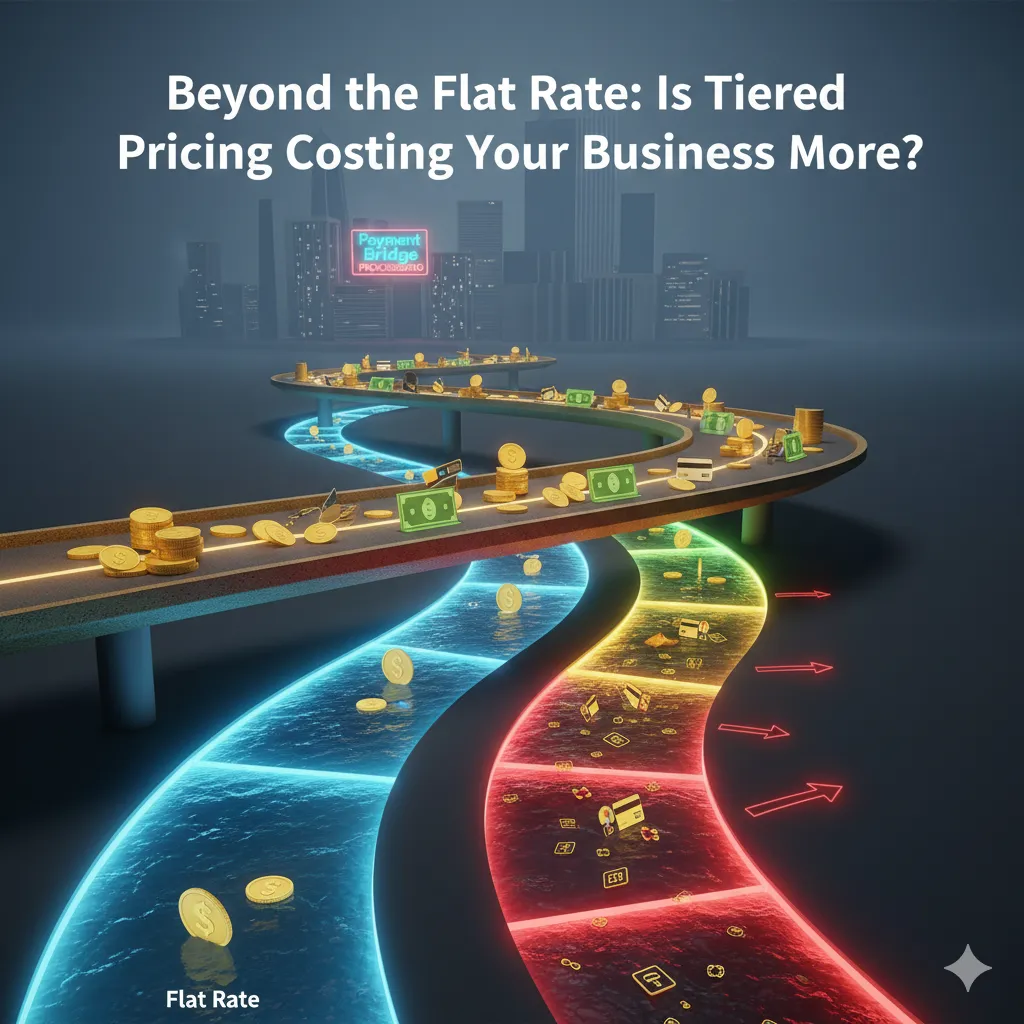
Beyond the Flat Rate: Is Tiered Pricing Costing Your Business More?
When I first started in the payment industry, I sat across from a small business owner who was incredibly proud of the "1.5% rate" he had just negotiated with a big-name processor. He thought he was winning. Then, we pulled up his actual monthly statement.
His effective rate, the total amount of money actually leaving his bank account, was closer to 4.2%.
How? He was stuck in the Tiered Pricing trap. Now, business owners look for every way to trim overhead, and the "Flat Rate" vs. "Tiered" debate is more relevant than ever. If you’ve ever felt like your merchant statement was written in a secret code, this is for you.
The "Bait and Switch" of Tiered Pricing
Tiered pricing is the oldest trick in the processor’s handbook. They lure you in with a "Qualified Rate" (the bait) that sounds impossibly low, sometimes as low as 1.0% or 1.5%.
But here is the catch: almost nothing actually "qualifies" for that rate.
Processors split your transactions into three buckets:
Qualified: Usually only standard, non-reward debit cards swiped in person.
Mid-Qualified: Rewards cards, loyalty cards, and some keyed-in transactions.
Non-Qualified: Business cards, international cards, and high-end "Elite" rewards cards (the ones your best customers probably use).
The "switch" happens when that 1.5% qualified rate turns into a 3.8% non-qualified rate because your customer wanted to earn airline miles. You have no control over what card your customer carries, yet you’re the one penalised for it.
Why Flat Rate Isn't Always the Hero?
On the other side, you have Flat Rate pricing (think Square or Stripe). It’s the "Netflix" of processing: one simple price for everything, usually around 2.6% to 2.9%.
For a brand-new business doing $2,000 a month, this is great. It’s predictable. But as you grow, flat-rate pricing becomes an expensive convenience. You are essentially paying a "premium" on every single transaction to avoid looking at a complicated statement. If a transaction actually only costs 1.8% to process, the flat-rate provider pockets that extra 1% as pure profit.
How to Spot the Red Flags?
If you’re reviewing your current setup, keep an eye out for these "bait and switch" warning signs:
1. The "Starting At" Trap: If a salesperson says your rate is "starting at 1.2%," they are talking about the Qualified Tier. Ask them what percentage of your actual sales they expect to fall into the Non-Qualified tier. If they can't (or won't) answer, walk away.
2. The Monthly Minimum "Junk Fee": Some tiered plans charge you a fee if you don't process a certain dollar amount. It’s a way to squeeze money out of you even during a slow month.
3. The "Inconsistent" Statement: In 2026, some legacy processors are still using paper statements or confusing PDFs that don't show the math. If you can’t easily see the card type vs. the rate charged, it’s usually because they are hiding a massive markup.
FAQs
Is Tiered Pricing ever better than Flat Rate?
Rarely. The only time Tiered Pricing works in your favour is if 90% of your customers use basic, non-reward debit cards. For most retail and service businesses today, Tiered Pricing is almost always the most expensive option.
What is the most transparent pricing model?
That would be Interchange-Plus. This is where the processor shows you the exact cost from the card brand (Visa/Mastercard) and adds a small, flat markup on top. It’s the only way to see exactly what you’re paying and why.
Why does my rate change when I key in a card manually?
When a card isn't physically present, the risk of fraud is higher. Banks charge more for that risk. In a Tiered model, this often "downgrades" the transaction to the most expensive Non-Qualified tier.
Can I switch from Tiered to Flat Rate easily?
Check your contract for an "Early Termination Fee." Some tiered providers lock you in for 3 years. At Payment Bridge Processing, we help merchants audit these contracts to find the cleanest way out.
The Bottom Line: Know Your Effective Rate
Don't get distracted by the "teaser" rates. To find out what you’re really paying, take your total fees for the month and divide them by your total sales volume. That is your Effective Rate.
If that number is over 3%, you are likely overpaying. We’re here to help you bridge that gap. At Payment Bridge Processing, we believe in showing you the "Plus" in the pricing, so you never have to wonder where your hard-earned profit is going.
