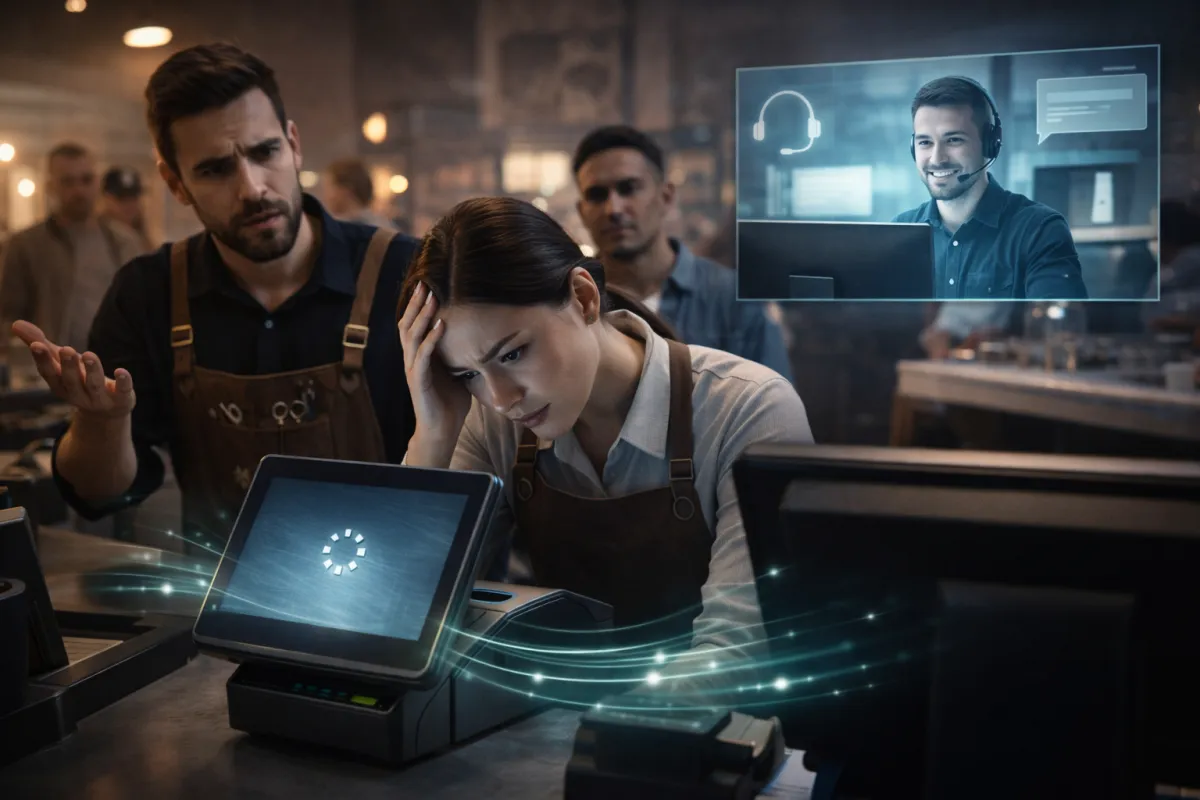
Why “24/7 Support” Matters: The Horror of System Outages on Friday Nights
If I run a business that depends on card payments, one of my biggest fears is not a slow afternoon. It is a busy Friday night when the POS freezes, the terminal disconnects, or checkout suddenly stops working.
That is the moment when “support” stops being a nice feature on a sales page and becomes the difference between keeping the line moving and watching revenue disappear in real time.
I think a lot of merchants underestimate this until it happens to them. A payment issue at 2 p.m. on a quiet Tuesday is frustrating. A payment issue during peak hours on Friday night is something else entirely. It creates stress for staff, embarrassment at the counter, longer wait times, angry customers, and immediate anxiety about lost sales. That is exactly why 24/7 support matters so much.
For Bridge Payment Processing, this topic is central to how the company presents itself. On its homepage, the business explicitly lists Dedicated 24/7 Technical Support among its core benefits, and its About page says its Merchant Success Team is available 24/7 to ensure your business never misses a beat. The company also positions itself around point-of-sale systems, terminals, mobile devices, secure gateways, broad software compatibility, and unified management tools through the Bridge Command Center.
Why Friday Night Is the Worst Time for a Payment Problem?
If I am honest, merchants do not usually worry about support because they love support. They worry about support because they know things can break at the worst possible moment.
Friday nights are especially brutal because that is when many businesses are busiest. Restaurants get slammed. Retail counters get crowded. bars, salons, service desks, and quick-turn businesses have more transactions coming through at once. When something goes wrong in those hours, I do not just lose one payment. I risk bottlenecks, abandoned purchases, staff confusion, and damage to the customer experience.
That is why I never view payment support as a background detail. When the system is down, support becomes part of operations.
A POS Crash Is Not Just a Technical Issue
One of the biggest mistakes I see is treating a POS failure like a simple IT inconvenience. It is not.
When the point-of-sale system or terminal stops working during peak hours, the damage spreads fast:
checkout lines slow down
staff lose confidence
managers stop focusing on customers and start troubleshooting
customers get frustrated
some people leave without buying
revenue stalls at the exact moment it should be strongest
Bridge Payment Processing’s site leans heavily into seamless integrations, user-friendly and reliable technology options, and end-to-end payment management, which makes sense because outages and friction usually hurt the business most at the moment of payment. The company also highlights that one customer saw a quicker and more efficient checkout process after switching, while another specifically praised its responsive Merchant Success Team.
The Real Horror Is Being Unable to Reach a Human Being
This is the part merchants hate most.
The outage is bad. The waiting is worse.
When a system goes down during peak hours, I do not want a maze of automated prompts, a generic ticket queue, or a chatbot that keeps asking me if I have restarted the terminal. I want a real person who understands merchant operations and can help me fix the issue quickly.
That is where the gap between human-centered service and big tech aggregator-style support becomes obvious. Large, volume-driven payment providers often sell convenience upfront, but when something mission-critical breaks, the merchant may feel like just another account in a support funnel. Bridge Payment Processing, by contrast, emphasizes dedicated 24/7 technical support and a Merchant Success Team as part of its brand positioning.
From my perspective, that matters because at 9:15 p.m. on a Friday, I am not comparing feature sheets anymore. I am asking one question:
Can I reach a real person who can actually help me?
Why Human-Centric Support Still Matters in Payments?
Payments are one of those business functions where automation is great right up until something fails.
I appreciate streamlined onboarding, cloud dashboards, and software integrations. But when a live problem hits the checkout flow, human support still matters because the situation is rarely abstract. It might involve:
a terminal not connecting
a POS integration failure
a gateway communication issue
a settlement or authorization problem
an employee unsure what to do next
multiple devices behaving inconsistently across locations
These are not just technical events. They are live business interruptions.
Bridge Payment Processing’s About page says the company focuses on long-term client relationships and provides exceptional service and support from its Merchant Success Team every step of the way. It also says its payment solutions are designed to be fast, secure, and cost-effective, while the homepage highlights broad hardware and software options, reliable technology, and centralized tools in the Bridge Command Center.
That combination matters because human support works best when it sits on top of a system the provider actually understands.
The Cost of an Outage Is Bigger Than One Lost Transaction
A lot of business owners think about outages too narrowly. They imagine the cost as “a few card payments we could not take.”
But the real cost is usually larger:
lost revenue during the busiest hours
staff time diverted into emergency troubleshooting
slower line movement
customer frustration
damage to the business’s reputation
managers pulled away from operations
stress that affects the whole shift
If the business has multiple terminals, mobile devices, or integrated systems, the confusion can grow quickly. Bridge Payment Processing positions itself as a provider of terminals, POS systems, mobile devices, e-commerce support, seamless point-of-sale integrations, and broad software compatibility, which is relevant because support quality becomes even more important as a business’s payment environment becomes more complex.
Why Peak-Hour Support Is Different From Regular Support?
Not all support situations are equal.
If I email support about a reporting question on a quiet morning, that is one kind of service. If my POS crashes while the dining room is full or my checkout counter is backed up, that is another.
Peak-hour support needs to be:
fast
reachable
practical
calm under pressure
familiar with real merchant workflows
This is why 24/7 support is not just about having a phone number available after business hours. It is about being staffed and structured to help when the stakes are highest.
Bridge Payment Processing’s language is unusually direct on this point. The homepage specifically lists Dedicated 24/7 Technical Support as a core offering, and the About page says the Merchant Success Team is available 24/7.
Why Big Aggregators Often Feel Different?
I think many merchants discover this the hard way.
Large payment aggregators can seem attractive because they are easy to sign up for and highly marketed. But when something goes wrong, merchants may find themselves pushed into generalized help centers, delayed escalations, or impersonal support channels.
I am not saying every large provider gives bad service. I am saying that service philosophy matters, especially for merchants who cannot afford downtime. Bridge Payment Processing clearly tries to differentiate on this front by emphasizing dedicated support, a Merchant Success Team, customizable solutions, and human assistance alongside its technology stack.
For businesses that operate during nights, weekends, or high-volume service windows, that difference can matter more than flashy marketing or self-serve onboarding.
24/7 Support Matters Most for Certain Types of Businesses
Almost any merchant benefits from real support, but some businesses feel the pain faster when systems fail.
I think about:
restaurants
bars
nightlife venues
retail stores with evening traffic
convenience businesses
salons and barbershops
service businesses with weekend volume
multi-location merchants
Bridge Payment Processing’s site includes a testimonial from a manager at a multi-location restaurant group, and another from a local business owner who praised faster checkout and better efficiency. Those examples support the idea that the platform is actively marketing to merchants whose operations depend on smooth real-time payment acceptance.
Support Is Also About Confidence for Staff
This part is easy to overlook, but it matters a lot.
When my team knows real help is available, they stay calmer during problems. They are less likely to panic, improvise bad workarounds, or escalate confusion to customers. They know there is a path to resolution.
That matters because a payment outage is stressful enough. The last thing I want is for my staff to feel stranded at the register with no one to call.
Bridge Payment Processing’s brand language around a Merchant Success Team and ongoing support suggests it wants merchants to feel backed up beyond the initial account setup. The company also says its solutions come with support and training services that help businesses maximize revenue with less risk.
Why the Technology Still Matters Too?
Good support is critical, but I do not see it as a substitute for good infrastructure. The best outcome is a provider that combines reliable tools with accessible humans.
Bridge Payment Processing presents exactly that kind of mix on its site through:
terminals
POS systems
mobile devices
e-commerce tools
secure gateway integration
proactive security and compliance
advanced analytics and reporting
recurring billing and invoicing
a centralized Bridge Command Center for transactions, reports, reconciliation, and disputes
That matters because support is strongest when the provider can see and understand the merchant’s broader payment environment, not just one isolated device.
What I Would Look for in a Payment Partner After-Hours?
If I am choosing a provider with Friday-night realities in mind, I would ask:
Is support truly available 24/7?
Can I reach a human, not just automated workflows?
Does the provider understand POS, terminals, and integrations together?
Is there a Merchant Success or technical team that stays involved after setup?
Do they offer centralized reporting and visibility if something goes wrong?
Are they built for businesses that process payments during nights and weekends?
Bridge Payment Processing’s website supports strong answers on several of those points, especially around 24/7 technical support, Merchant Success Team availability, versatile hardware and software options, seamless POS integrations, and unified visibility through the Bridge Command Center.
How Bridge Payment Processing Fits This Conversation?
Based on the site, Bridge Payment Processing is not trying to position itself as just another low-touch payment platform. It presents itself as a more service-oriented partner, with a mix of modern payment technology and human-centered support.
Its key positioning includes:
Dedicated 24/7 Technical Support
a Merchant Success Team available 24/7
user-friendly and reliable technology options
seamless point-of-sale integrations
broad software compatibility
simplified management tools
the Bridge Command Center as a central hub for transactions, reports, reconciliation, customer information, and chargeback management
For a merchant worried about POS crashes during peak hours, that combination is meaningful. It suggests the company understands that payments are not just about processing rates. They are about operational continuity.
Final Thoughts
If I run a business where weekends, evenings, and peak hours drive serious revenue, then 24/7 support is not optional. It is part of my risk management.
A POS outage on Friday night is not just annoying. It is one of the fastest ways to create lost sales, long lines, frustrated staff, and shaken customer confidence. The horror is not only the outage itself. It is the feeling of being unable to reach a real person while money is walking out the door.
That is exactly why Bridge Payment Processing’s emphasis on Dedicated 24/7 Technical Support and a Merchant Success Team available 24/7 stands out. Combined with its broader payment stack, POS integrations, hardware options, and Bridge Command Center, the company is clearly trying to solve the human side of payment problems, not just the technical one.
